
Floor coatings for busy warehouses and factories
A warehouse floor sees much more than footsteps. Loaded pallet trucks, turning forklifts, stationary equipment and goods set down in the same place can put very different demands on a coating. We begin by understanding those movements, then plan the floor around them.
For industrial epoxy flooring in Jeddah, tell us which areas carry the hardest use and which can be taken out of service. A clear description of your operation is more useful than asking for the thickest available finish. We specify the concrete preparation, coating and installation stages around that use.
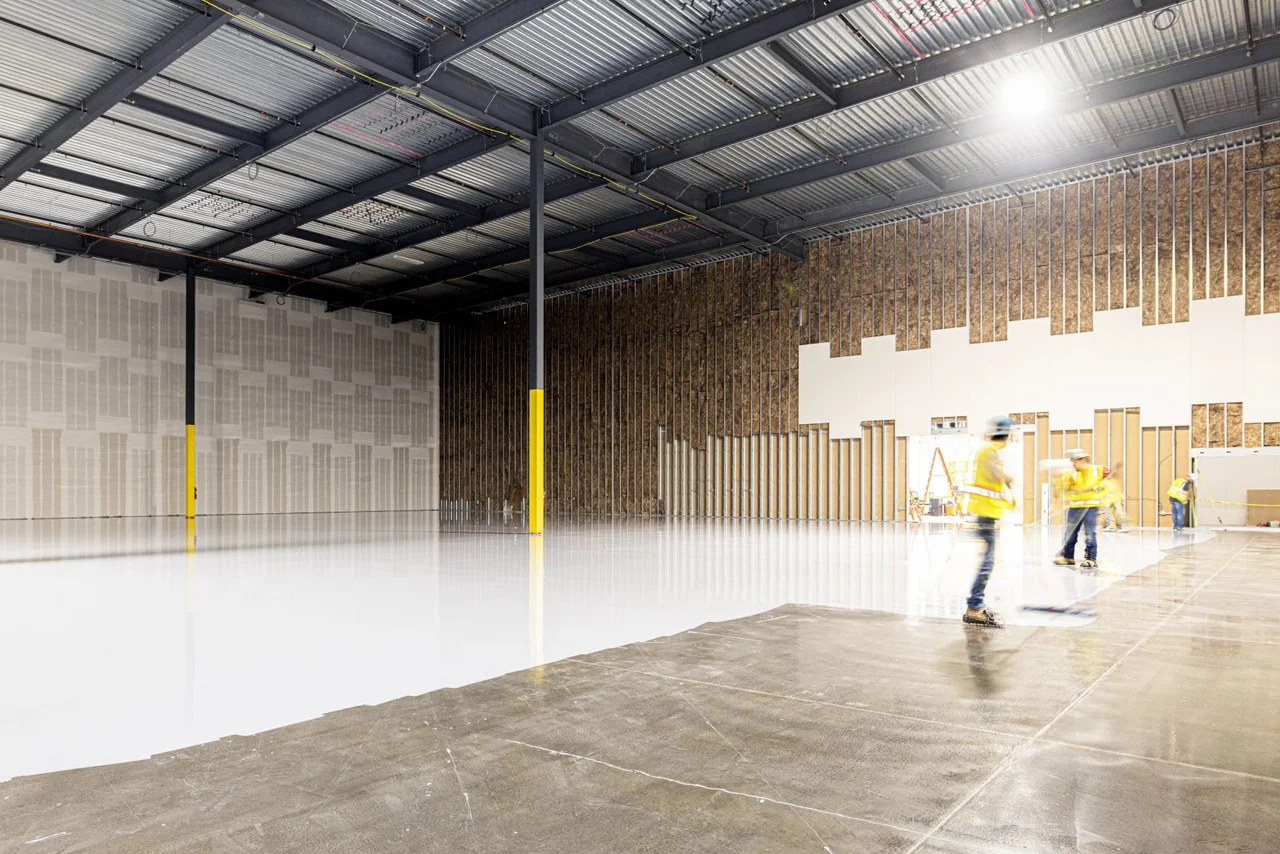
Forklift routes, workstations and damaged joints
Loaded routes and turning points
Mark the routes between storage, loading and production. Include wheel types, typical loads and the places where vehicles brake or turn. These details help identify where wear and stress are concentrated. A decorative specification for an office is not the starting point for a loading aisle.
Workstations and cleaning zones
List the substances that reach the floor and how they are cleaned away. Chemical resistance is specific to the substance, concentration, temperature and contact time. We do not treat a generic epoxy label as proof of resistance to every process fluid.
Edges, joints and thresholds
Forklift routes can expose weak joint edges long before a large open area looks worn. Describe damaged thresholds, joint movement and raised transitions. They may need repair detailing beyond a new coloured surface.
Concrete preparation and repairs
New coating cannot make unsound concrete reliable. We assess surface strength, contamination, previous treatments and moisture before agreeing the preparation. Grinding or another appropriate mechanical method must suit the substrate and coating system.
If oil has penetrated a work area, simply washing the surface may not resolve it. Local treatment, further investigation or removal may be needed. Cracks are assessed for their nature and movement; a moving joint should not disappear from the plan just because a seamless appearance is preferred.
The output should be a defined preparation and repair scope. That is the part to scrutinise when comparing quotations. If an allowance depends on what is revealed after removal, it should be described openly rather than hidden inside a confident-looking square-metre rate.
Plan installation around your operating hours
An empty building is straightforward to isolate. A working facility needs a more deliberate plan. We discuss whether work can proceed by aisle, room or operational zone, and what must stay reachable throughout.
Barrier positions, storage relocation, preparation dust control, ventilation and access to equipment belong in the plan. So do the handover conditions for each completed area. A surface can look finished while still needing time before loaded wheels or cleaning chemicals are introduced.
Phasing is useful only if the remaining routes can safely support your operation. Do not assume that coating alternating strips will always keep a building running. Share your site rules, shift pattern and any unavoidable shutdown dates so the sequence can be assessed realistically.
What is included in an industrial flooring quote?
The scope should identify the area and intended traffic, required preparation, local repairs, primer and coating build-up, finish texture and any agreed markings. It should also explain exclusions such as structural repairs or equipment relocation.
Thickness is selected for the specified system and use. An isolated thickness number is not enough to compare two offers with different preparation or materials. Where specialist performance is required, provide the project specification and evidence requirements before requesting a price.
For the factors that affect the total, use our epoxy flooring cost guide. Industrial work is priced from the floor condition and operating constraints, not from a universal warehouse rate.
Assessing wear along forklift routes
If your main problem is wear along one vehicle route, begin there. Identify the wheels, the loads and the turns, then compare the condition of that route with the quieter storage bays. This can help separate traffic wear from a wider adhesion issue.
The assessment may support different treatment in different zones, or show that the whole base needs attention. Either way, the decision is made from the operating conditions. Keep a copy of the agreed layout so markings, repair boundaries and future maintenance can be understood by the next person responsible for the facility.
Reopening and caring for your industrial floor
Before putting the space back into use, agree the release points for foot traffic, vehicles and full operation. Keep cleaning guidance with the floor records so later maintenance teams know what the surface was designed for.
If your current floor is still broadly sound but has isolated worn areas, an assessment of repair and recoating may be a practical alternative to specifying complete replacement. If a smooth continuous body coat is the priority, see our self-levelling epoxy guide.
Send the industrial estate name, a floor plan if available, approximate area, loading information and the condition of the worst sections. We will use those details to focus the next conversation on the decisions that matter.
FREQUENTLY ASKED QUESTIONS
Epoxy flooring questions answered
Can work be divided around operating shifts?
A phased plan may be possible where sections can be isolated and alternate routes remain usable. The cure window, ventilation, equipment movement and site rules still need to be agreed.
Does an epoxy floor provide chemical resistance?
Resistance depends on the selected system and the actual chemical exposure. Supply the substance, concentration, temperature and likely contact time so suitability can be checked against technical documentation.
Can you coat around fixed machinery?
That depends on access for preparation and finishing, and on whether the equipment or adjacent operation can be protected. Include machinery footprints and restricted clearances in the initial scope.